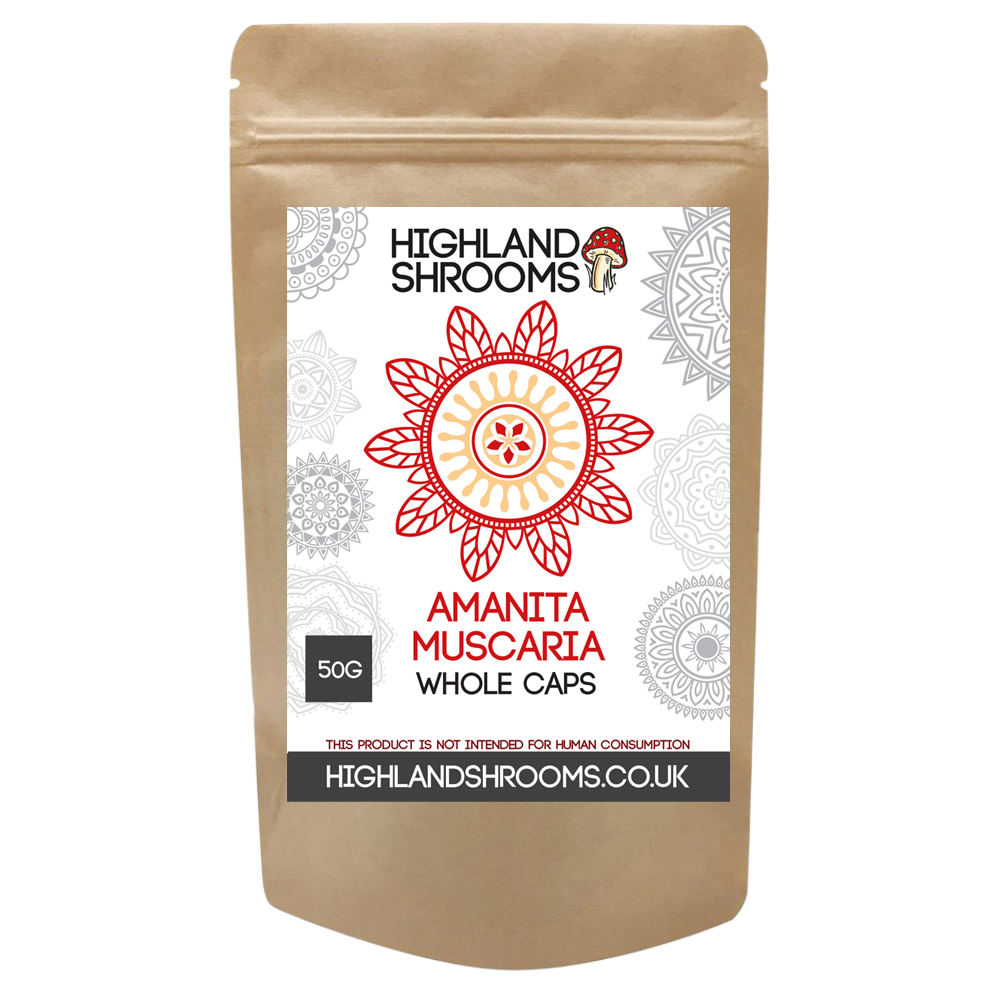

50g Dried Amanita Muscaria Dried Whole Caps
£30.00
8 in stock
- Estimated Delivery : Up to 5 business days
- Free Shipping & Returns : On all orders over £50
Dried Amanita Muscaria Mushrooms (Fly Agaric) – Botanical Specimens for UK Research
Potent, Distinctive Fly Agaric Caps for Botanical Research Only
These dried Amanita muscaria caps are sold as botanical specimens for microscopy, taxonomy, and mycological research. They are not food, not a supplement, and not approved for human or animal consumption. The mushroom Amanita muscaria is a toxic species within the genus Amanita, and every pouch we sell carries clear labelling to that effect.
We ship from within the UK, with fast, trackable delivery to England, Scotland, Wales, and Northern Ireland. Whether you are building a university herbarium, running a fungal identification workshop, or studying the fruiting body structure of poisonous mushrooms under a microscope, these specimens give you identifiable, well-preserved fly agaric material year-round.
Freshly Fermented sources and prepares each batch with attention to morphological integrity. We are a specialist fungi and fermentation retailer; our interest in this species is strictly botanical. This product is not a tea ingredient, a smoking blend, a tincture, or an extract. It exists so researchers, educators, and mycology enthusiasts in the UK can study one of the northern hemisphere’s most recognisable and well-documented fungal species.
Why UK Researchers Choose These Amanita Muscaria Specimens
Each benefit below addresses a practical need for people working with dried fly agaric mushrooms in a botanical or educational setting.
- Reliable visual identification – Caps retain the bright red cap with white warts that makes the fungus Amanita muscaria instantly recognisable. The appearance of Amanita muscaria features a bright red cap with white spots, and our specimens preserve those veil remnants, gill structure, and cap surface detail so students can compare morphological features against field guide descriptions and related species such as Amanita pantherina.
- Consistent drying and preservation – Caps are carefully dehydrated at 40–50 °C to maintain colour, wart adhesion, and structural form. Ibotenic acid converts to muscimol when dried or heated, which alters the chemical composition; our low-temperature method balances structural preservation with predictable post-drying chemistry for researchers who need to document the specimen’s condition accurately.
- Convenient year-round availability – In the UK, fly agaric fruits from roughly August through November, with regional variation depending on rainfall and temperature. Dried specimens let you teach, photograph, or study the species outside that narrow window, including during spring and summer mushrooms courses when fresh material is unavailable.
- Ethically and responsibly sourced – Mushrooms are collected from European woodlands where the species is abundant, forming mycorrhizal associations with birch, pine, and spruce. Foragers avoid overharvesting and take care not to damage mycelial networks or tree roots.
- Supplied by a specialist fungi retailer – Highland Shrooms works with fungi and microorganisms across our full product range. That background informs how we handle, dry, label, and ship Amanita muscaria mushrooms, even though this particular product is never intended for ingestion.
What Sets Our Amanita Muscaria Specimens Apart
Unlabelled, home-dried caps purchased from informal sellers often arrive with unknown origin, inconsistent drying methods, missing warts, and no harvest date. These gaps make taxonomic record-keeping unreliable and can introduce confusion between Amanita muscaria var. muscaria and other Amanita species with an orange yellow cap or faded colouration.
- Clear labelling and traceable origin – Every pouch includes the scientific name, common name (fly agaric), country of origin, and drying year. This supports institutional record-keeping and lets researchers cite provenance in coursework or publications.
- Visually graded material – We select only caps with recognisable fly agaric features: intact yellowish warts or white warts, characteristic red skin, and visible cap margin. Mature specimens with washed-off or absent warts are set aside rather than mixed in, reducing the risk of confusion with a separate species.
- Research-focused presentation – Product images and descriptions are oriented toward microscopy, taxonomy, and educational display. We do not use language or packaging that implies consumption, recreational use, or any association with psychoactive drugs or legal highs.
How to Use These Specimens (Research & Educational Context Only)
All instructions below relate to non-ingestive use: observation, photography, and study. This product must not be eaten, brewed, smoked, or otherwise ingested.
- Unpack safely Open the sealed pouch on a clean, dry surface. Wearing gloves is optional but recommended if you prefer to avoid direct skin contact with the dried material. Avoid inhaling dust or spore fragments during unpacking.
- Macroscopic study Examine cap colour (ranging from deep scarlet to orange-red in dried form), wart patterning, cut surface, and any remaining veil fragments. High-resolution photographs are useful for field guide comparisons, coursework portfolios, or scientific illustration reference. Note that colour fading over time is normal; fresh-dried specimens show the most vivid red.
- Microscopic work Prepare small fragments of gill tissue or cap cuticle (pileipellis) for microscopy. Spores of Amanita muscaria are inamyloid, smooth, and oval to ellipsoid, typically measuring 8.5–13 × 6.5–9 µm in UK specimens. This data point helps confirm identification and distinguish fly agaric from other amanita mushrooms.
- Documentation and comparison Record observations alongside sketches or photographs. Compare specimens with UK field guides and academic references on the genus Amanita. Note any variation in wart density, cap margin striation, or gill colouration; these differences reflect natural field variation, not product defects.
- Safe storage and disposal Return remaining material to its labelled, airtight pouch. Store out of reach of children and pets. Dispose of unwanted material in sealed bags with household waste. Never compost dried fly agaric or treat it as food waste.
Product Details
Scannable specifications for the dried fly agaric product.
- Material / format: Dried Amanita muscaria (fly agaric) mushroom caps, supplied as whole or large broken pieces retaining identifiable morphological features.
- Approximate weight options: 10g and 50g resealable pouches. Individual cap sizes vary; a typical mature cap measures 10–20 cm across when fresh, so each pouch may contain one large cap or several smaller sections.
- Origin: European woodlands where the species is common (UK and EU countries), primarily from birch woodland, mixed conifer plantations, and heathland with acidic soils.
- Processing method: Low-temperature drying (40–50 °C) with no additives, flavourings, solvents, or chemical agents. Caps are brush-cleaned before drying to preserve wart integrity.
- Packaging: Resealable, light-protective pouches with internal desiccant sachet. Each pouch is labelled with scientific name, common name, harvest date, drying date, country of origin, and “Not for human consumption; botanical specimen only.”
- Shelf life: Up to 12–24 months when stored cool, dry, and away from direct sunlight. This refers to structural and visual integrity, not edibility. Colour may gradually fade and brittleness may increase over time.
- Safety notice: Not for human consumption. Sold as a botanical specimen only.
Who These Amanita Muscaria Specimens Are For
These specimens serve specific UK and EU customer groups with a genuine need for preserved fly agaric material.
- Mycology students and educators – Anyone teaching or studying fungal identification who needs a classic, immediately recognisable example of a toxic Amanita species. Dried specimens allow side-by-side comparison with images of hallucinogenic fungi, edible lookalikes, and other poisonous mushrooms without requiring a foraging trip.
- Botanists and natural history enthusiasts – Hobbyists building personal reference collections or herbarium-style archives focused on UK and European fungi. A well-preserved fly agaric cap is a reference point for understanding the broader amanita genus.
- Artists and photographers – Creatives who want real fly agaric material for scientific illustration, macro photography, or nature artwork. The species has deep roots in folklore and fantasy, often linked to winter traditions; Amanita muscaria is linked to the myth of Santa Claus’s flying reindeer, and it has been called both a divine mushroom and a sacred mushroom across Siberian and Mesoamerican cultures, making it a compelling visual subject.
- Institutions and clubs – Natural history societies, conservation groups, and foraging organisations that use dried specimens during talks and workshops to demonstrate the difference between edible and toxic species.
If you are looking for edible mushrooms, psychoactive mushrooms, or anything marketed as a magic mushroom product, this listing is not for you. Unlike psilocybin mushrooms, which are a controlled substance in the UK under the Misuse of Drugs Act 1971, Amanita muscaria occupies a different legal and pharmacological category. We sell it strictly for non-consumption purposes.
Amanita Muscaria at a Glance: Key Botanical Facts
This section summarises the natural-history details UK customers most commonly ask about when purchasing fly agaric for research.
Identification and Morphology
The appearance of Amanita muscaria is among the most recognised of any fungal species worldwide. A mature fruiting body displays a scarlet to bright red cap scattered with white or slightly yellowish warts (remnants of the universal veil), white free gills, a white stem with a prominent ring (annulus), and a bulbous base encasing the volva. Cap diameter in UK specimens typically ranges from 10 to 20 cm; stem height reaches roughly 20–25 cm, with stem thickness of 10–25 mm.
Field variation is common. Warts may be fewer or absent if washed off by rain. Cap colour can shift from deep scarlet to orange-red. The cap margin becomes slightly striated with age. Spore print is white; spores are smooth, oval to ellipsoid. These variations do not indicate a separate species; they reflect normal environmental exposure. The term “fly agaric” originates from its use in traditional practices to attract or kill flies, and the latin word musca (fly) gives the species its name.
Distribution in the UK and Europe
Amanita muscaria is widespread across the UK, growing in mycorrhizal association with birch, pine, and spruce. It favours light, acidic soils in birch woodland, mixed conifer plantations, and heathland. Fruiting peaks between August and November, triggered by rainfall, falling temperatures, and shorter daylight hours. Individual fruiting bodies persist for one to three weeks depending on weather conditions.
Beyond Britain, the species is native across the northern hemisphere, throughout northern and central Europe and into North America. It has also been introduced via pine plantations to parts of the Southern Hemisphere, including Australia and New Zealand.
Toxicity and Chemical Interest (For Information Only)
Amanita muscaria contains muscimol and ibotenic acid as primary compounds. Muscimol is a GABA receptor agonistaffecting the central nervous system, with structural similarity to gamma aminobutyric acid (also written as gamma amino butyric acid). Ibotenic acid can convert to muscimol when dried or heated through decarboxylation. A single fruiting body may contain 6mg of muscimol; an active dose is approximately 6mg of muscimol. Muscazone is another compound found in Amanita muscaria, formed partly through photochemical transformation during light exposure. Muscimol induces euphoria and altered perception at active doses.
Psychoactive effects can include visual and auditory hallucinations, and symptoms peak within three hours after ingestion. Amanita muscaria is not considered a safe edible mushroom and can cause unpredictable poisoning. Symptoms of poisoning include dizziness, confusion, and seizures. A lethal dose of Amanita muscaria is estimated at 15 caps, though fatal poisonings are rare with modern medical intervention. The species does not contain the amatoxins (e.g., α-amanitin) responsible for liver failure in some other Amanita species. Muscimol and ibotenic acid are the main toxic compounds in A. muscaria, and their pharmacological effects on GABA receptors have attracted neuropharmacological research interest, including studies on whether compounds like baclofen ameliorate cognitive deficits in models of streptozocin induced Alzheimer’s disease. Other compounds and other components in the fruiting body remain subjects of further research, including investigations into antioxidant properties and the potential to regulate protein expression in dsRNA activated human microglia and reduce proinflammatory cytokines.
Amanita muscaria can cause severe gastrointestinal distress if ingested raw or improperly prepared. There is no established therapeutic use for consuming Amanita muscaria, despite purported benefits circulating online. Commercial products featuring Amanita muscaria may lack reliable dosing and labelling. Clinical trials have not validated any therapeutic potential for human consumption. The psychoactive compound muscimol crosses the blood brain barrier, which is why even very low doses scaled to body weight can produce effects on the human brain.
This product is not intended for ingestion, extraction, or self-experimentation. It is sold for botanical observation only.
Safety, Handling and Legal Considerations (UK Context)
Responsible handling matters when working with a toxic species, even in a research or display context.
- Not for consumption – These dried mushrooms must not be eaten, brewed, smoked, or otherwise ingested. They are botanical specimens. Removing the skin of Amanita muscaria can reduce psychoactive effects, and boiling reduces toxicity, but neither process makes the species safe. Discarding cooking water after boiling further detoxifies the mushroom in traditional preparation methods; none of these methods are endorsed or recommended by Freshly Fermented. Amanita muscaria poisoning has occurred in young children; in 2023, four cases of poisoning were reported in Lithuania. Lithuanians historically mixed Amanita muscaria with vodka for wedding feasts, and the Koryak people used Amanita muscaria in rituals and for relaxation, but historical use does not equal safety.
- Safe storage – Store specimens in their original labelled pouch, sealed, in a cool, dry location out of reach of children and pets. A locked drawer or cupboard is appropriate if there is any risk of accidental access. Including a silica gel sachet helps maintain low humidity.
- Handling advice – Wash hands after handling. Avoid contact with eyes or mouth. Gloves are advisable during extended laboratory work or when preparing microscopy slides. Avoid inhaling dust from fragmented specimens.
- UK legal status (informational) – At the time of writing, Amanita muscaria is not listed as a controlled substance under the Misuse of Drugs Act 1971 in the UK. It is not a controlled drug. However, the Psychoactive Substances Act 2016 applies to such substances if supplied with the intent or recklessness regarding psychoactive use. Products sold clearly as non-food botanical specimens, with appropriate labelling, operate within this framework. Amanita muscaria is largely unregulated in the EU; in Poland, Amanita muscaria is not classified as a controlled substance. In Lithuania, Amanita muscaria will be banned in 2025. In the U.S., Amanita muscaria is unscheduled but listed as a poison, and the FDA banned Amanita muscaria in food products in December 2024. Amanita muscaria was proposed as the Vedic Soma by R. Gordon Wasson, and it has been used in Siberian shamanic rituals, but none of this cultural history changes its legal or safety status when sold in the UK. Amanita muscaria is recognised in folklore and fantasy, often linked to winter traditions. These are not psychotropic drugs, not psychoactive drugs in the scheduled sense, and not analogous to psilocybin mushrooms in their hallucinogenic properties or legal classification. The species has psychoactive properties, but it is sold here for research, not for drug addiction treatment, recreational use, or any purpose involving adverse effects on the central nervous system.
- When in doubt – Check current UK guidance or contact relevant authorities if you plan to use specimens within formal institutions, exhibitions, or educational settings.
Frequently Asked Questions
Common queries from UK-based customers ordering dried Amanita muscaria for research.
Is this safe to keep at home?
When stored sealed, clearly labelled, and out of reach of children and pets, dried fly agaric is suitable for home reference collections. The specimens remain toxic; they must never be mistaken for a food product or handled carelessly. Treat them as you would any preserved specimen of poisonous mushrooms in a personal or institutional collection.
Can I eat, brew or smoke these mushrooms?
No. This product is sold for botanical and educational purposes only. It is not intended or approved for any form of consumption, inhalation, or extraction. Amanita muscaria can be consumed as a tincture or extract in some cultural traditions, but Freshly Fermented does not provide consumption advice, does not endorse recreational or self-medicating use, and does not sell this product for any purpose related to psychoactive effects or hallucinogenic fungi. Muscimol’s effects on the central nervous system, including visual hallucinations and auditory hallucinations, carry real risks. Drying increases potency by converting ibotenic acid to muscimol; these are not summer mushrooms you can casually prepare.
Do you ship Amanita muscaria across the UK?
Freshly Fermented ships from within the UK to England, Scotland, Wales, and Northern Ireland, subject to any future regulatory changes. Orders are packed discreetly with clear internal labelling so you can identify the contents upon opening.
How should I store the specimens for long-term study?
Keep pouches in a cool, dry place away from sunlight and moisture. Under these conditions, structural and visual features remain identifiable for 12–24 months. If you open the pouch frequently for teaching or photography, reseal promptly or transfer specimens to airtight, clearly labelled jars. Colour fading from red toward orange or yellow is a natural degradation process in dried material.
Can I use these specimens for teaching mushroom safety?
Many customers, including foraging instructors, biology teachers, and natural history society leaders, use dried fly agaric as a visual aid. The species is a textbook example of mushroom poisoning risk, and dried specimens help illustrate the difference between edible and toxic species without requiring a live foraging session. Keep specimens securely stored when not in use, and emphasise toxicity and non-edibility in every session. Muscaria poisoning is rare with proper medical context and medical intervention, but the species should always be treated with caution as a teaching tool.
Ready to Add Amanita Muscaria to Your Research Collection?
Order dried Amanita muscaria specimens from Freshly Fermented for your UK-based research, teaching, or botanical collection. Every pouch ships with traceable origin data, clear safety labelling, and the morphological detail you need for identification work and microscopy.
Add to cart and benefit from fast UK delivery and responsive customer support.
Botanical research and educational display only. Not for human consumption.
Related products
-

-

-
Amanita Regalis Extract | Dual Extracted Ultrasonic Extract 50ml
Original price was: £25.00.£15.00Current price is: £15.00. -